
This page is intended to provide some basic information on the remote sensing of atmospheric aerosols to those who are relatively new to the field.
Experienced users can skip this page.
What is a dark target retrieval and why do we need it?
As you can see in the illustration below the photons reaching the top of the atmosphere (TOA) and detected by the satellite first weave a complex path through the atmosphere.

The optical signal measured by the satellite detector contains information contributed by all of the factors on the right. We have to desconstruct that signal and remove everything leaving only what we want which is the portion contributed by the aerosols. This is known as Aerosol Optical Depth (AOD) a unitless value used to represent total column aerosol loading.
All algorithms which measure AOD have to account for the relatively large signal coming from the surface. A dark target algorithm does this by looking for the aerosol and surface signals over dark surfaces. The reason for this is that in general atmospheric aerosols will brighten a scene. This assumption works best when the underlying surface is dark but tends to break down over brighter surfaces. The dark target algorithm selects dark surfaces in the scene where it can most accurately determine the surface signal and remove it from the total.
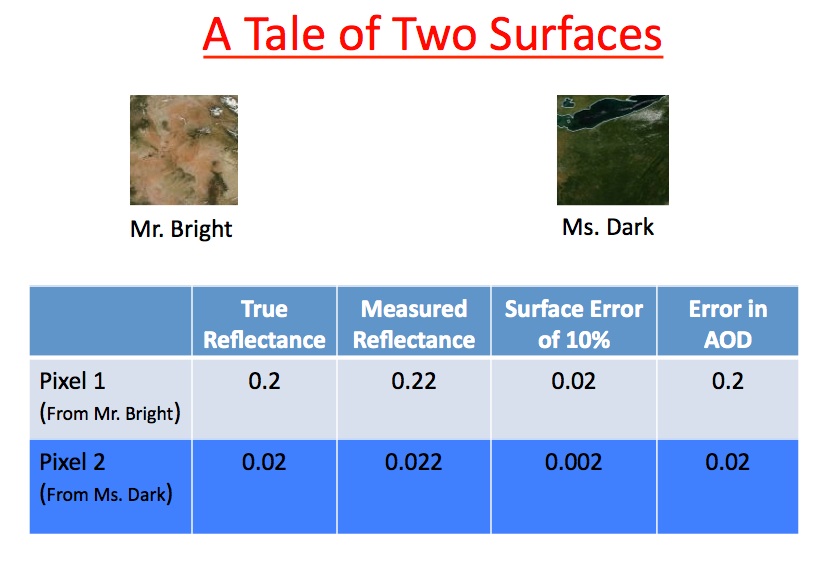
The tale of two surfaces depicted above illustrates the effect of errors in the measurement of the surface reflectance on the calculated AOD. Assuming that an error in the measurement of the surface reflectance propogates to a factor of 10 error in the AOD you can see that the selection of dark pixels limits the errors due to surface effects.